
The Compression System: Psycho-Pass
What it takes to turn complex people into real-time decisions

You're walking down the street.
Nothing feels unusual. The city moves the way it always does—quiet, orderly, predictable. People pass by without looking at each other. Cars slow at the intersections. A normal day, indistinguishable from the last.
Then the scan happens.
You don't see it.
You don't hear it.
But something shifts.
Not in the world—but in how the world is about to respond to you.
A number appears.
Before you speak.
Before you act.
Before intent fully settles into something you could explain, even to yourself.
For a brief second, you feel it—
a flicker of something you can't quite name.
Not fear. Not yet. Just the sense that a decision has already been made.
The response is immediate.
Because it doesn't need to understand you.

Core Law
Action requires compression.
Understanding is too slow to matter.
Every system that acts on the world eventually runs into the same constraint:
It cannot wait for complete information.
It cannot resolve every contradiction.
It cannot afford to interpret every nuance of human behaviour before making a decision.
Action demands reduction.
Something has to be removed—context, history, intent—until what remains is small enough to process and fast enough to act on. The system does not ask whether the representation is complete. It only matters whether it is usable.
Only whether it is sufficient.
Because in this model, delay isn't neutral.
Delay is failure.
Context: The System Behind the Scan
To understand what the system is doing, it helps to ground it.
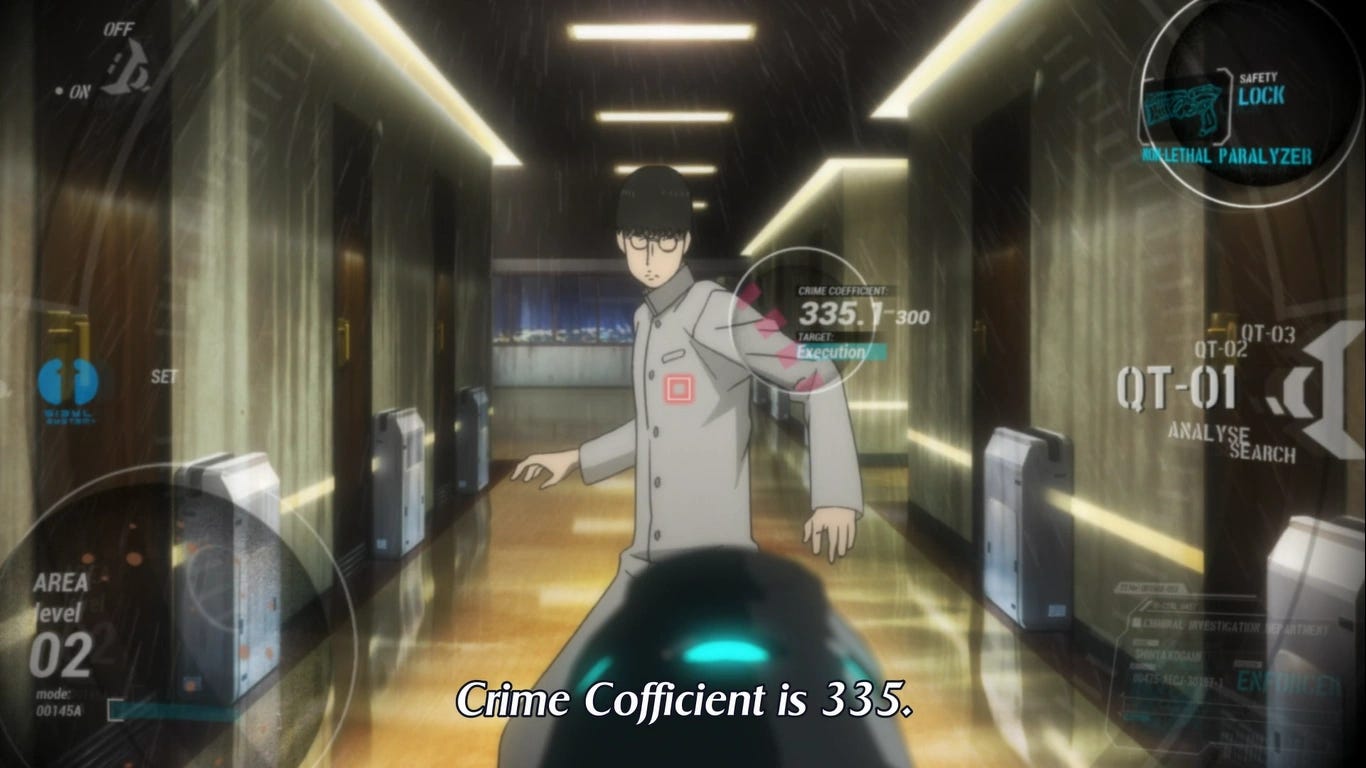
In Psycho-Pass, the society operates under the Sibyl System—an invisible network that continuously evaluates every individual and assigns them a “Crime Coefficient.” This number represents the system’s assessment of how likely a person is to commit a crime.
It’s based on what the system believes you might do.
Mental state, stress levels, behavioural patterns—everything is translated into a score. And once that score crosses a certain threshold, intervention begins.
Not after harm occurs.
Before.
On the surface, this looks like safety. A world where crime is prevented before it happens, where uncertainty is minimized, where risk is managed proactively.
But underneath that promise is something more fundamental:
a system designed to act faster than human judgment ever could.
Product Framing: Decision Infrastructure
This is not a justice system.
It is decision infrastructure.
At its core, the system solves a very specific problem: how do you make decisions about people in real time, at scale, without waiting for full understanding?
To do that, it transforms people into something actionable.
Its function is simple:
Take complex, evolving human behaviour
Convert it into a stable, interpretable signal
Enable immediate action
It does not attempt to understand people fully. It attempts to make them legible.
And what it sells is not safety.
It sells speed.
In environments where uncertainty is constant, a usable answer is more valuable than a correct one. The system is designed around that tradeoff from the ground up.
System Constraint: The Cost of Ambiguity
Once a system is responsible for acting on people, ambiguity becomes a liability.
In most real-world systems, ambiguity is tolerated. Sometimes it's even necessary. Human judgment depends on it—context can be interpreted, intent can be debated, and decisions can be delayed until more information becomes available.
This system does not have that option.
It operates under a different set of constraints:
Decisions must be continuous
Decisions must be immediate
Decisions must be consistent
Ambiguity slows all three. So it gets removed.
Not because it isn't real—but because it isn't usable.
User Problem: Why This System Exists
Humans are too complex to evaluate in real time.
Intent is unstable. What someone feels in one moment can shift in the next. Context is inconsistent—behaviour that seems harmless in one setting may signal risk in another. And interpretation takes time, often more time than a system designed to prevent harm can afford.
But decisions don't wait.
At scale, hesitation becomes its own kind of risk. A system responsible for maintaining order cannot pause every time uncertainty appears. It has to act on partial information, incomplete signals, and constantly changing states.
Which leads to a fundamental problem:
How do you act on something you don't fully understand?
You compress it until you can.
Core Capabilities
For such a system to work, compression cannot be occasional. It has to be continuous, operational, and reliable at scale.
That requires a very specific set of capabilities—not features in the traditional sense, but mechanisms that make real-time judgment possible.
At a high level, three things are happening at all times:
Continuous Quantification
Human behaviour is not observed intermittently—it is measured constantly. Mental state, stress, micro-behaviours, environmental context—all of it is translated into signals. The goal isn't to understand any one moment deeply, but to ensure nothing exists outside the model's visibility.Real-Time Scoring
These signals are immediately processed into a single, legible output: the Crime Coefficient. Complexity collapses into a number. Not because a number is accurate, but because it is actionable. A decision-maker—human or otherwise—can respond to a score far faster than they can interpret a person.Threshold-Based Action
The system does not deliberate. It compares. Once a score crosses a predefined threshold, the response is triggered. There is no second layer of understanding, no pause for reconsideration. The threshold is the decision.
Together, these capabilities create something that looks like judgment, but behaves very differently.
There is no moment where the system "understands" a person and then decides what to do. Instead, understanding and interpretation is bypassed entirely. Signals are captured, compressed, and resolved into action in a single flow.
What makes this powerful is not accuracy.
It's consistency.
Every input is processed the same way. Every output is comparable. Every decision can be made without hesitation.
And at scale, that kind of consistency starts to look like certainty.
Product Requirement Document
At this point, what felt like observation resolves into something more precise.
System: Human Compression System
Product Definition
A decision infrastructure that converts complex human behaviour into real-time, actionable signals.
User Problem
Human judgment is slow, inconsistent, and difficult to scale.
Critical decisions cannot wait for full understanding.
Core Capabilities
Continuous behavioural quantification
Real-time risk scoring
Threshold-based intervention
Constraints
Must operate faster than human cognition
Cannot tolerate ambiguity
Requires universal coverage
Metrics
Decision latency
False negatives (critical)
System-wide stability
Failure Modes
Self-reinforcing classifications
Irreversible threshold crossings
Loss of contextual nuance
Ethical Boundary
Defines when a person becomes actionable.
What It Optimizes For
On the surface, the system is designed to reduce crime. That's the stated purpose. A world where harm is prevented before it occurs, where risk is identified early and neutralized efficiently.
But that's not what it actually optimizes for.
It optimizes for actionability.
The goal is not to be right in an absolute sense. It's to produce a decision that can be executed immediately and consistently. In that context, a slightly imperfect answer that arrives on time is more valuable than a perfectly accurate one that arrives too late.
Over time, this reshapes what "success" means inside the system:
Speed > Understanding
Consistency > Nuance
Stability > Fairness
What emerges is a system that prefers a reliable signal over a truthful representation.
Because truth is slow.
And slowness, in this model, is indistinguishable from failure.
Tradeoffs
To achieve that level of speed and consistency, something has to give.
In this case, it's everything that makes human behaviour difficult to model in the first place.
Nuance is the first casualty. Context—the thing that gives meaning to behaviour—is flattened into generalized signals. A reaction triggered by grief, stress, or circumstance is processed the same way as one driven by intent.
Time is another loss. People change, often unpredictably. But a system optimized for stability cannot afford to re-evaluate constantly. It has to treat signals as durable enough to act on, even when they are not.
And then there's ambiguity itself—the space where interpretation happens, where doubt exists, where judgment requires patience. That space is removed entirely.
The tradeoff is clear:
To make decisions faster, the system gives up the ability to understand deeply. And once that tradeoff is accepted, it cannot be selectively reversed.
Every decision inherits it.
Failure Modes
The most interesting failures aren’t edge cases.
They are direct consequences of the system working exactly as intended.
One of the first is self-reinforcement. When a person is classified a certain way, every action they take is interpreted through that lens. Over time, behavior begins to align with the classification—not necessarily because it was accurate, but because it became unavoidable.
Another is irreversibility. Once a threshold is crossed, returning becomes statistically unlikely. Not because people cannot change, but because the system no longer treats them as someone who can.
And then there is category collapse. Outliers—people who don’t fit cleanly into defined patterns—are forced into the nearest available classification. The system resolves uncertainty by eliminating it, even when that elimination introduces distortion.
None of these are bugs.
They are the natural outcome of a system that prioritizes decisiveness over interpretation.
Human Consequence
Over time, people adapt.
Not to the world as it is, but to how they are measured within it.
When every internal state has the potential to be quantified and acted upon, behavior shifts. Emotions are regulated, not for personal well-being, but for external readability. Stress is suppressed. Reactions are moderated. Even thought patterns begin to align with what the system rewards.
The result is subtle, but pervasive:
People stop optimizing for who they are.
They start optimizing for how they are seen.
Authenticity becomes secondary to legibility.
And internal life—once private, inconsistent, and fluid—becomes something that must be managed carefully, because it is no longer just experienced.
It is evaluated.
Ethical Boundary
At its core, the system makes a single decision.
It determines when a person becomes actionable.
Not guilty.
Not innocent.
Not even dangerous in the traditional sense.
Actionable.
That distinction matters.
Because once a person is defined in those terms, intervention no longer requires justification in the way it once did. The threshold itself becomes the justification.
The system does not ask whether someone deserves to be acted on.
It decides when they qualify.
Closing Reflection
What makes this system unsettling isn’t its extremity.
It’s its familiarity.
The idea that complex human behavior can be reduced into signals. That decisions can be automated once those signals cross a threshold. That speed and consistency can be prioritized over interpretation.
These are not distant ideas.
They already exist—just in less visible, less absolute forms.
The difference here is not direction.
It’s completion.
This is what happens when a system is allowed to fully optimize for action.
Everything else becomes negotiable.